RELEASE 06 / DOW-UAP-D153
DOW-UAP-D153, AAWSAP DIRD, Quantum Tomography of Negative Energy States in the Vacuum, January 2011
- File ID
- DOW-UAP-D153
- Agency
- Department of War
- Release
- Release 06, 18 Sep 2026
- Event date
- 1/11/2011 (read as 11 Jan 2011; precision: day)
- Location
- Las Vegas, Nevada
- Type
- Redactions
- Yes, parts of the official copy are blacked out
The official record
Official copy at war.gov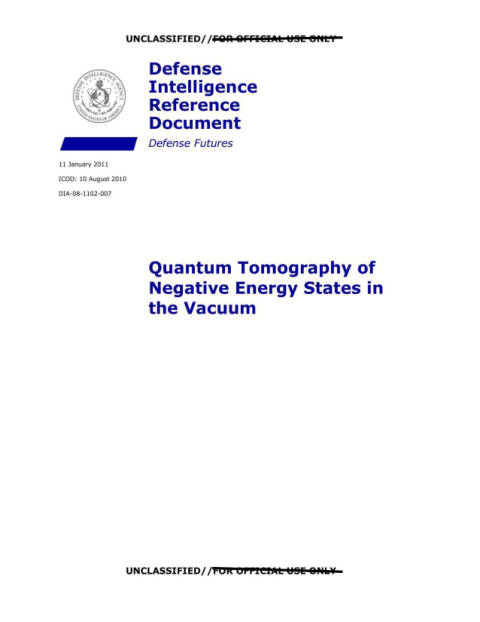
Official summary, as published
This document is a Defense Intelligence Reference Document (DIRD), a technical reference format used by the Defense Intelligence Agency (DIA) to capture baseline knowledge on a specific topic for later analytic use. DIRDs are best understood as reference and synthesis products rather than as original research. It is one of 38 DIRDs produced under the Advanced Aerospace Weapon System Applications Program (AAWSAP) between 2009 and 2011. Because AAWSAP’s scope permitted a broad range of supporting topics, not every DIRD in the series directly concerns aerospace systems or future threat assessment. The following summary reflects the DIRD’s scope and framing at the time of writing and should not be read as implying current validation of the concepts discussed.
This DIRD examines how negative-energy, or “sub-vacuum,” states in quantum fields might be detected and mapped. Its practical scope is limited to the laboratory-scale measurement of minute quantum effects, though it extrapolates from those effects to consider theoretical relevance to concepts such as warp drives, wormholes, or gravitational control. By reviewing previously identified laboratory examples such as the Casimir effect and squeezed light states, the report identifies the core technical challenge as mapping their spatial and temporal structures reliably. To address this, it proposes quantum optical homodyne tomography as a method to reconstruct and quantify the vacuum fluctuations associated with these states. The document acknowledges that only microscopic, transient negative-energy effects have been realized in laboratory settings. It remains unknown whether larger or longer-lived distributions of such effects can be generated or stabilized, particularly given the experimentally unresolved constraints imposed by quantum inequalities. Overall, this DIRD functions as a measurement- and diagnostics-oriented review intended to lay experimental groundwork for a far more ambitious, highly speculative negative-energy research agenda.
Named in this file
6 namesPeople, programs and institutions from The Legacy Program research board whose names appear in this file, found by exact spelling against a hand-checked list. A match says only that the file names them, not what part they play. People and programs lists every file that names each one.
- Tier C Ulf Leonhardt person
Named in pages 20, 23, 24, 25, 29, 30, 33, 35 and 3 more.
Theoretical physicist, University of St Andrews; author, DIRD 'Invisibility Cloaking: Theory and Experiments' (DIA-08-1003-001)
- Tier A Eric W. Davis person
Named in page 50.
Astrophysicist, EarthTech International; five-time AAWSAP DIRD author
- Tier B Marc G. Millis person
Named in page 50.
Former NASA propulsion engineer, founder of the Tau Zero Foundation; author, DIRD 'Cockpits in the Era of Breakthrough Flight' (DIA-08-1011-002)
- Tier A Advanced Aerospace Weapon System Applications Program (AAWSAP) program
Named in the title and the official summary.
dia-program
- Tier A Defense Intelligence Agency institution
Named in the official summary and pages 1, 2.
Combat support agency; AAWSAP/AATIP executive agent
- Tier B Federal Aviation Administration institution
Named in page 19.
Civil aviation regulator in the Department of Transportation; first-listed contributing agency to NARA Record Group 615
Our reading
Reading in progress
We have not published a reading of DOW-UAP-D153 yet. The official summary above is all there is for now.
Our saved copy
One version seen. The checksum lets you confirm that a copy you hold is the one we saved.
-
First seen
64.3 MB (67,407,068 bytes)
SHA-256
bc2dc83edc60634dd69e8cb0dd2acdc3e1e1bfe598a70bcd6feb462a7422183e