RELEASE 06 / DOW-UAP-D151
DOW-UAP-D151, AAWSAP DIRD, Cognitive Limits on Simultaneous Control of Multiple Unmanned Spacecraft, December 2010
- File ID
- DOW-UAP-D151
- Agency
- Department of War
- Release
- Release 06, 18 Sep 2026
- Event date
- 12/15/2010 (read as 15 Dec 2010; precision: day)
- Location
- Las Vegas, Nevada
- Type
- Redactions
- Yes, parts of the official copy are blacked out
The official record
Official copy at war.gov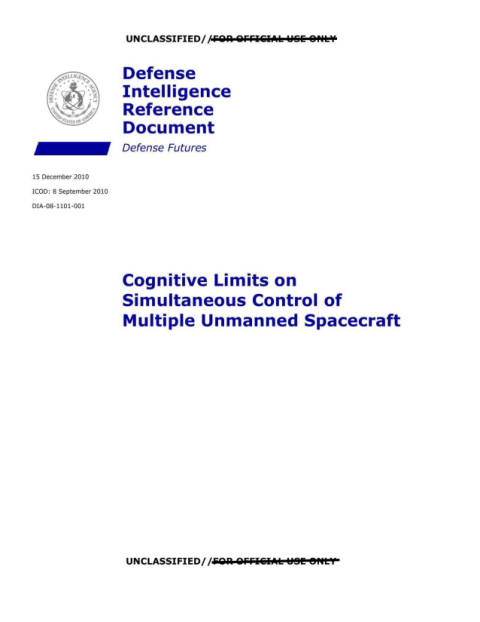
Official summary, as published
This document is a Defense Intelligence Reference Document (DIRD), a technical reference format used by the Defense Intelligence Agency (DIA) to capture baseline knowledge on a specific topic for later analytic use. DIRDs are best understood as reference and synthesis products rather than as original research. It is one of 38 DIRDs produced under the Advanced Aerospace Weapon System Applications Program (AAWSAP) between 2009 and 2011. Because AAWSAP’s scope permitted a broad range of supporting topics, not every DIRD in the series directly concerns aerospace systems or future threat assessment. The following summary reflects the DIRD’s scope and framing at the time of writing and should not be read as implying current validation of the concepts discussed.
This DIRD examines how many unmanned spacecraft a single human operator could realistically supervise or control at once, using research from air traffic control and multi-vehicle remote piloting as rough analogs. The report argues that the practical limit depends heavily on task complexity: about 16 craft for simple monitoring or destination assignment, about 7 for moderately complex piloting or mission tasks, and about 4 for complex heterogeneous operations. It places particular emphasis on the operator’s ability to maintain a coherent mental “big picture” of multiple vehicles at once, and it suggests that automation and external displays can help by offloading working-memory demands, though not eliminating them. The document also highlights physiological workload measures as a possible way to detect or predict operator overload in real time. Overall, it presents multi-spacecraft control as a human-factors and systems-integration problem in which progress depends on managing cognitive limits through interface design, automation, and workload monitoring.
Named in this file
4 namesPeople, programs and institutions from The Legacy Program research board whose names appear in this file, found by exact spelling against a hand-checked list. A match says only that the file names them, not what part they play. People and programs lists every file that names each one.
- Tier A Advanced Aerospace Weapon System Applications Program (AAWSAP) program
Named in the title and the official summary.
dia-program
- Tier A Defense Intelligence Agency institution
Named in the official summary and pages 1, 3.
Combat support agency; AAWSAP/AATIP executive agent
- Tier A National Aeronautics and Space Administration institution
Named in pages 8, 14, 19, 20, 29.
Civil space agency; host of the 2023 UAP Independent Study Team
- Tier B Federal Aviation Administration institution
Named in pages 13, 17.
Civil aviation regulator in the Department of Transportation; first-listed contributing agency to NARA Record Group 615
Our reading
Reading in progress
We have not published a reading of DOW-UAP-D151 yet. The official summary above is all there is for now.
Our saved copy
One version seen. The checksum lets you confirm that a copy you hold is the one we saved.
-
First seen
38.6 MB (40,463,687 bytes)
SHA-256
7535e88d474d47ec980b7e35a394f532b297aafb1e32170e044bcc1a7b016402