RELEASE 06 / DOW-UAP-D150
DOW-UAP-D150, AAWSAP DIRD, Quantum Computing and Utilizing Organic Molecules in Automation Technology, December 2010
- File ID
- DOW-UAP-D150
- Agency
- Department of War
- Release
- Release 06, 18 Sep 2026
- Event date
- 12/10/2010 (read as 10 Dec 2010; precision: day)
- Location
- Las Vegas, Nevada
- Type
- Redactions
- Yes, parts of the official copy are blacked out
The official record
Official copy at war.gov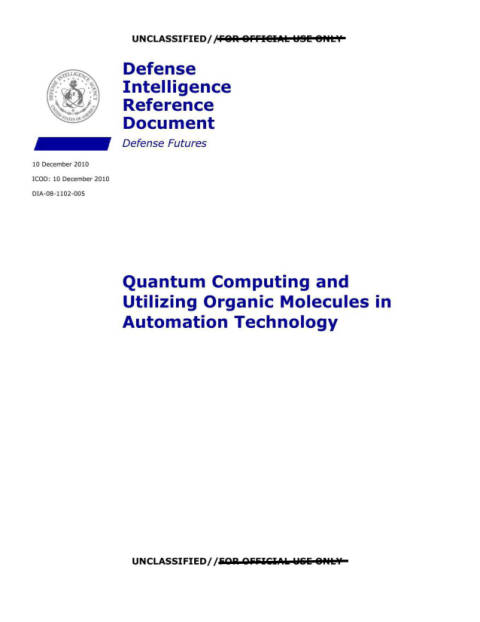
Official summary, as published
This document is a Defense Intelligence Reference Document (DIRD), a technical reference format used by the Defense Intelligence Agency (DIA) to capture baseline knowledge on a specific topic for later analytic use. DIRDs are best understood as reference and synthesis products rather than as original research. It is one of 38 DIRDs produced under the Advanced Aerospace Weapon System Applications Program (AAWSAP) between 2009 and 2011. Because AAWSAP’s scope permitted a broad range of supporting topics, not every DIRD in the series directly concerns aerospace systems or future threat assessment. The following summary reflects the DIRD’s scope and framing at the time of writing and should not be read as implying current validation of the concepts discussed.
This DIRD surveys advanced computing concepts for future space and automation applications, focusing on quantum and molecular (DNA-based) computing as potential alternatives to conventional silicon electronics. The report introduces quantum computing principles alongside DNA-based logic gates, self-assembly, and nanoscale repair mechanisms, arguing that these unconventional architectures might eventually offer advantages in radiation tolerance, physical robustness, and specialized onboard processing for space-based platforms. It notes that near-term practical barriers remain substantial. Quantum systems continue to depend on complex cryogenics, shielding, and unsolved reliability challenges, while DNA-based computing remains a far-future concept rather than a viable alternative to general-purpose processors. Overall, the document presents both frameworks as long-term possibilities to complement, rather than immediately replace proven space-qualified electronics. It concludes that the stronger, nearer-term cases for such architectures are in highly specialized or hybrid roles rather than in fully mature general-purpose onboard computing applications.
Named in this file
4 namesPeople, programs and institutions from The Legacy Program research board whose names appear in this file, found by exact spelling against a hand-checked list. A match says only that the file names them, not what part they play. People and programs lists every file that names each one.
- Tier A Advanced Aerospace Weapon System Applications Program (AAWSAP) program
Named in the title and the official summary.
dia-program
- Tier A Defense Intelligence Agency institution
Named in the official summary and pages 1, 2.
Combat support agency; AAWSAP/AATIP executive agent
- Tier A National Aeronautics and Space Administration institution
Named in page 9.
Civil space agency; host of the 2023 UAP Independent Study Team
- Tier B Federal Aviation Administration institution
Named in page 40.
Civil aviation regulator in the Department of Transportation; first-listed contributing agency to NARA Record Group 615
Our reading
Reading in progress
We have not published a reading of DOW-UAP-D150 yet. The official summary above is all there is for now.
Our saved copy
One version seen. The checksum lets you confirm that a copy you hold is the one we saved.
-
First seen
70.2 MB (73,640,604 bytes)
SHA-256
decf55cd5ddbb9dbd437466c7d3557ffc02a4cde5fafdfabc19fca8ce180bc28