RELEASE 06 / DOW-UAP-D149
DOW-UAP-D149, AAWSAP DIRD, MHD Air Breathing Propulsion and Power for Aerospace Applications, November 2010
- File ID
- DOW-UAP-D149
- Agency
- Department of War
- Release
- Release 06, 18 Sep 2026
- Event date
- 11/21/2010 (read as 21 Nov 2010; precision: day)
- Location
- Las Vegas, Nevada
- Type
- Redactions
- Yes, parts of the official copy are blacked out
The official record
Official copy at war.gov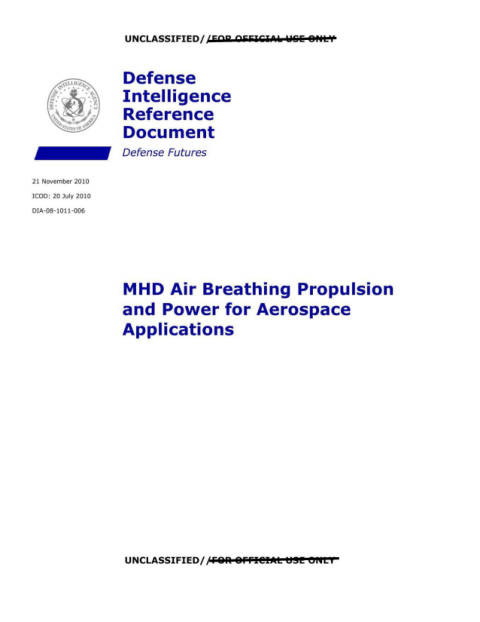
Official summary, as published
This document is a Defense Intelligence Reference Document (DIRD), a technical reference format used by the Defense Intelligence Agency (DIA) to capture baseline knowledge on a specific topic for later analytic use. DIRDs are best understood as reference and synthesis products rather than as original research. It is one of 38 DIRDs produced under the Advanced Aerospace Weapon System Applications Program (AAWSAP) between 2009 and 2011. Because AAWSAP’s scope permitted a broad range of supporting topics, not every DIRD in the series directly concerns aerospace systems or future threat assessment. The following summary reflects the DIRD’s scope and framing at the time of writing and should not be read as implying current validation of the concepts discussed.
This DIRD surveys magnetohydrodynamic (MHD) and plasma-based concepts for air-breathing propulsion, onboard power generation, and aerodynamic control, arguing that such systems could in principle extend aerospace performance beyond the limits of conventional chemical propulsion and control surfaces. The report reviews concepts including MHD acceleration, flow control, inlet control, onboard power generation, drag reduction, and plasma-generated “virtual” aerodynamic surfaces, while giving particular attention to hypersonic applications such as scramjet power extraction, reentry vehicles, global-strike gliders, and aero-assisted orbital maneuvers. However, it emphasizes major practical constraints, especially extreme power requirements, system weight and complexity, and the difficulty of achieving useful ionization in colder air at lower hypersonic speeds; on that basis, it argues that Ajax-style MHD bypass concepts, in which energy is extracted from the airflow upstream and reintroduced downstream through an electromagnetic system, are not meaningful below about Mach 12, while treating the “virtual cowl” and related reentry applications as more plausible. The document presents plasma and MHD aerospace systems as a technically serious but highly demanding field whose nearer-term promise lies in specialized hypersonic control, power generation, and reentry applications rather than a fully realized air-breathing propulsion system.
Named in this file
4 namesPeople, programs and institutions from The Legacy Program research board whose names appear in this file, found by exact spelling against a hand-checked list. A match says only that the file names them, not what part they play. People and programs lists every file that names each one.
- Tier A Advanced Aerospace Weapon System Applications Program (AAWSAP) program
Named in the title and the official summary.
dia-program
- Tier A Defense Intelligence Agency institution
Named in the official summary and pages 1, 2.
Combat support agency; AAWSAP/AATIP executive agent
- Tier B Federal Aviation Administration institution
Named in pages 6, 16, 19, 21.
Civil aviation regulator in the Department of Transportation; first-listed contributing agency to NARA Record Group 615
- Tier A National Aeronautics and Space Administration institution
Named in pages 12, 22.
Civil space agency; host of the 2023 UAP Independent Study Team
Our reading
Reading in progress
We have not published a reading of DOW-UAP-D149 yet. The official summary above is all there is for now.
Our saved copy
One version seen. The checksum lets you confirm that a copy you hold is the one we saved.
-
First seen
40.9 MB (42,853,776 bytes)
SHA-256
a885a20dcb94555eb91adaddb3461313f8a79a6289de3fe1aa9530cc0aaa6aca