RELEASE 06 / DOW-UAP-D148
DOW-UAP-D148, AAWSAP DIRD, Detection and High-Resolution Tracking of Vehicles at Hypersonic Velocities, November 2010
- File ID
- DOW-UAP-D148
- Agency
- Department of War
- Release
- Release 06, 18 Sep 2026
- Event date
- 11/20/2010 (read as 20 Nov 2010; precision: day)
- Location
- Las Vegas, Nevada
- Type
- Redactions
- Yes, parts of the official copy are blacked out
The official record
Official copy at war.gov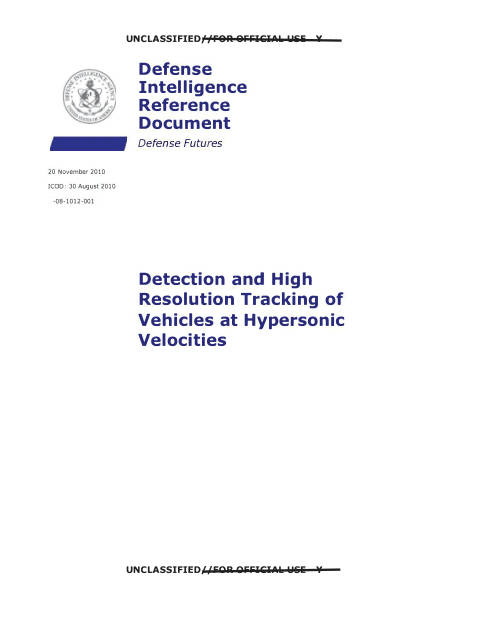
Official summary, as published
This document is a Defense Intelligence Reference Document (DIRD), a technical reference format used by the Defense Intelligence Agency (DIA) to capture baseline knowledge on a specific topic for later analytic use. DIRDs are best understood as reference and synthesis products rather than as original research. It is one of 38 DIRDs produced under the Advanced Aerospace Weapon System Applications Program (AAWSAP) between 2009 and 2011. Because AAWSAP’s scope permitted a broad range of supporting topics, not every DIRD in the series directly concerns aerospace systems or future threat assessment. The following summary reflects the DIRD’s scope and framing at the time of writing and should not be read as implying current validation of the concepts discussed.
This DIRD surveys how hypersonic vehicles may be detected and tracked by exploiting the physical effects they create in flight, especially shock waves, ionized gas, hot surfaces, and turbulent atmospheric wakes. The report reviews a broad set of detection methods, including radar, infrared sensing, optical imaging, LIDAR, passive radio reflection, infrasound, and seismic techniques, and argues that the most effective systems will likely combine multiple sensor types, because each captures different features of a high-speed vehicle’s passage through the atmosphere. It presents radar and infrared sensing as the strongest existing tools for operational detection, while giving particular attention to wake-based methods such as LIDAR and passive radio techniques for improving tracking, identification, and discrimination of future hypersonic aircraft. The paper identifies hypersonic vehicles as an evolving surveillance problem in which future progress will depend on better multi-sensor integration, improved wake characterization, and novel signature-exploitation techniques.
Named in this file
7 namesPeople, programs and institutions from The Legacy Program research board whose names appear in this file, found by exact spelling against a hand-checked list. A match says only that the file names them, not what part they play. People and programs lists every file that names each one.
- Tier A Advanced Aerospace Weapon System Applications Program (AAWSAP) program
Named in the title and the official summary.
dia-program
- Tier A Defense Intelligence Agency institution
Named in the official summary and page 2.
Combat support agency; AAWSAP/AATIP executive agent
- Tier A RAND Corporation institution
Named in page 27.
Nonprofit operator of four FFRDCs (Project AIR FORCE, Arroyo Center, National Defense Research Institute, HSOAC); Santa Monica, CA; est. 1948 out of Project RAND (1946)
- Tier B Strategic Air Command (SAC) institution
Named in page 27.
The USAF major command that owned every installation in this cluster; the institutional spine of the nuclear-incursion record, 1946 to 1992
- Tier B Los Alamos National Laboratory institution
Named in pages 30, 31.
DOE FFRDC administered by Triad National Security, LLC since 9 June 2018; Los Alamos, NM
- Tier A National Aeronautics and Space Administration institution
Named in pages 32, 33, 34.
Civil space agency; host of the 2023 UAP Independent Study Team
- Tier B Air Force Research Laboratory institution
Named in page 34.
Single Air Force science and technology laboratory, headquartered at Wright-Patterson AFB, Ohio
Our reading
Reading in progress
We have not published a reading of DOW-UAP-D148 yet. The official summary above is all there is for now.
Our saved copy
One version seen. The checksum lets you confirm that a copy you hold is the one we saved.
-
First seen
46.2 MB (48,470,373 bytes)
SHA-256
5586486eaafe104a32a83964ae2f1849432838e01b59308200b5b6f48aeeb490