RELEASE 06 / DOW-UAP-D143
DOW-UAP-D143, AAWSAP DIRD, Laser Lightcraft Nanosatellites, November 2010
- File ID
- DOW-UAP-D143
- Agency
- Department of War
- Release
- Release 06, 18 Sep 2026
- Event date
- 11/1/2010 (read as 1 Nov 2010; precision: day)
- Location
- Las Vegas, Nevada
- Type
- Redactions
- Yes, parts of the official copy are blacked out
The official record
Official copy at war.gov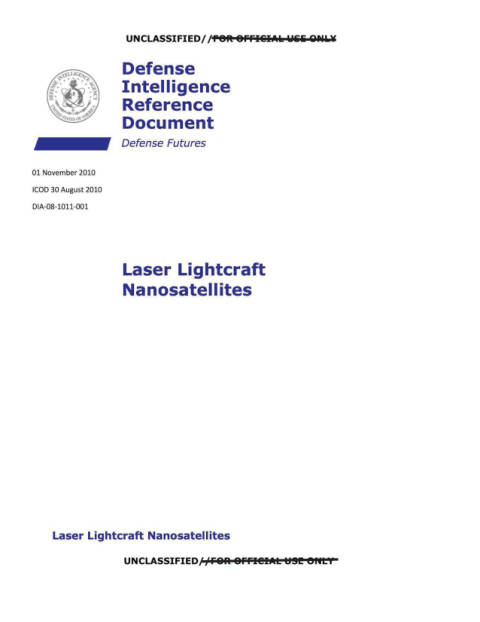
Official summary, as published
This document is a Defense Intelligence Reference Document (DIRD), a technical reference format used by the Defense Intelligence Agency (DIA) to capture baseline knowledge on a specific topic for later analytic use. DIRDs are best understood as reference and synthesis products rather than as original research. It is one of 38 DIRDs produced under the Advanced Aerospace Weapon System Applications Program (AAWSAP) between 2009 and 2011. Because AAWSAP’s scope permitted a broad range of supporting topics, not every DIRD in the series directly concerns aerospace systems or future threat assessment. The following summary reflects the DIRD’s scope and framing at the time of writing and should not be read as implying current validation of the concepts discussed.
This DIRD examines laser-propelled “Lightcraft” as a possible low-cost method to launch very small satellites into low Earth orbit by using a remote high-energy laser to supply most of the propulsion energy rather than relying entirely on onboard energy sources. The report combines a survey of nanosatellite trends with a review of “Lightcraft” propulsion concepts, vehicle design, beam-control requirements, and mission studies, and argues that the most promising application is the launch of nano- or pico-satellites, especially Earth- and space-observing payloads of a few kilograms or less. It presents the concept as potentially much cheaper than conventional multistage rockets for very small payloads, while also noting significant practical constraints including strict beam-riding geometry, atmospheric losses, demanding pointing and adaptive-optics requirements, and heavy dependence on large ground-, sea-, or air-based laser infrastructure. Overall, the document presents laser “Lightcraft” as a technically plausible launch concept whose attractiveness depends on whether the supporting laser and beam-control system can be made reliable and economical at operational scale.
Named in this file
9 namesPeople, programs and institutions from The Legacy Program research board whose names appear in this file, found by exact spelling against a hand-checked list. A match says only that the file names them, not what part they play. People and programs lists every file that names each one.
- Tier C J. Albertine person
Named in page 53.
Directed Technologies; high-energy laser physicist, M.S.; probably John R. Albertine, formerly of the US Navy High Energy Laser Program Office
- Tier A Advanced Aerospace Weapon System Applications Program (AAWSAP) program
Named in the title and the official summary.
dia-program
- Tier A Defense Intelligence Agency institution
Named in the official summary and pages 1, 2.
Combat support agency; AAWSAP/AATIP executive agent
- Tier B Air Force Research Laboratory institution
Named in pages 3, 15, 16, 17, 18, 19, 20, 21 and 9 more.
Single Air Force science and technology laboratory, headquartered at Wright-Patterson AFB, Ohio
- Tier A National Aeronautics and Space Administration institution
Named in pages 17, 33, 74, 75.
Civil space agency; host of the 2023 UAP Independent Study Team
- Tier B Federal Aviation Administration institution
Named in pages 25, 29, 35, 45, 47, 49, 51, 53 and 8 more.
Civil aviation regulator in the Department of Transportation; first-listed contributing agency to NARA Record Group 615
- Tier C General Atomics institution
Named in pages 53, 55, 56.
Privately held; fusion research, unmanned aircraft, DOE and DARPA programs
- Tier B Lawrence Livermore National Laboratory institution
Named in page 75.
DOE FFRDC administered by Lawrence Livermore National Security, LLC since 1 October 2007; Livermore, CA
- Tier A Sandia National Laboratories institution
Named in page 75.
DOE national laboratory, Albuquerque, NM
Our reading
Reading in progress
We have not published a reading of DOW-UAP-D143 yet. The official summary above is all there is for now.
Our saved copy
One version seen. The checksum lets you confirm that a copy you hold is the one we saved.
-
First seen
83.0 MB (87,076,089 bytes)
SHA-256
2e88690520b8175d657e18b9ba3de5b9e07c9be21b304a044e2e1d48f5cb9193