RELEASE 06 / DOW-UAP-D140
DOW-UAP-D140, AAWSAP DIRD, High-Frequency Gravitational Wave Communications, April 2010
- File ID
- DOW-UAP-D140
- Agency
- Department of War
- Release
- Release 06, 18 Sep 2026
- Event date
- 4/6/2010 (read as 6 Apr 2010; precision: day)
- Location
- Las Vegas, Nevada
- Type
- Redactions
- Yes, parts of the official copy are blacked out
The official record
Official copy at war.gov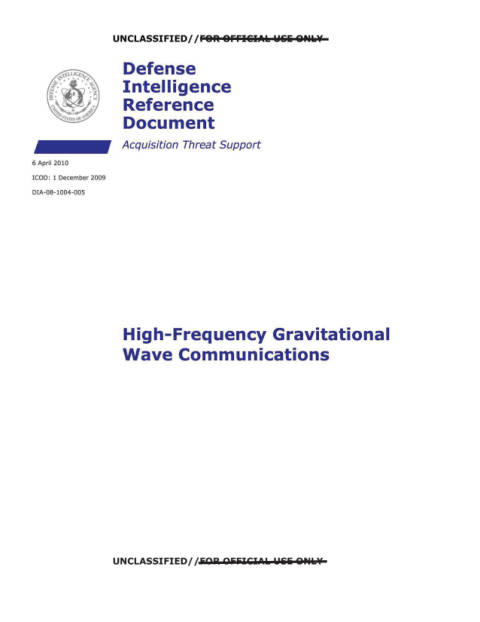
Official summary, as published
This document is a Defense Intelligence Reference Document (DIRD), a technical reference format used by the Defense Intelligence Agency (DIA) to capture baseline knowledge on a specific topic for later analytic use. DIRDs are best understood as reference and synthesis products rather than as original research. It is one of 38 DIRDs produced under the Advanced Aerospace Weapon System Applications Program (AAWSAP) between 2009 and 2011. Because AAWSAP’s scope permitted a broad range of supporting topics, not every DIRD in the series directly concerns aerospace systems or future threat assessment. The following summary reflects the DIRD’s scope and framing at the time of writing and should not be read as implying current validation of the concepts discussed.
This DIRD examines whether high-frequency gravitational waves could serve as a communications medium while avoiding the attenuation that limits radio-frequency systems. The report surveys proposed transmitter and detector concepts, argues that gravitational-wave communications could support secure point-to-point links, timing standards, and interplanetary navigation, and gives particular attention to laboratory generator concepts and the Li-Baker detector as possible building blocks for such a system. The document makes clear, however, that the entire concept depends on capabilities that had not been demonstrated in practice, including laboratory-scale generation and reliable detection of usable high-frequency gravitational-wave signals. It is an exploratory systems-oriented review built around a future communications concept.
Named in this file
7 namesPeople, programs and institutions from The Legacy Program research board whose names appear in this file, found by exact spelling against a hand-checked list. A match says only that the file names them, not what part they play. People and programs lists every file that names each one.
- Tier B Robert M. L. Baker, Jr. person
Named in page 50.
GravWave LLC; author, DIRD 'High-Frequency Gravitational Wave Communications' (DIA-08-1004-005) - commissioned after a JASON review rejected the underlying physics
- Tier A Advanced Aerospace Weapon System Applications Program (AAWSAP) program
Named in the title and the official summary.
dia-program
- Tier A Defense Intelligence Agency institution
Named in the official summary and pages 1, 2.
Combat support agency; AAWSAP/AATIP executive agent
- Tier A The MITRE Corporation institution
Named in pages 9, 44, 45, 47.
Not-for-profit operator of six FFRDCs; dual headquarters McLean, VA and Bedford, MA; founded 21 July 1958
- Tier A National Aeronautics and Space Administration institution
Named in pages 36, 53.
Civil space agency; host of the 2023 UAP Independent Study Team
- Tier B JASON institution
Named in page 44.
Independent standing scientific advisory group, est. 1960; administered successively by IDA, SRI International and MITRE
- Tier A Office of the Director of National Intelligence institution
Named in page 44.
Head of the 18-element Intelligence Community; co-signatory of the UAP reporting regime
Our reading
Reading in progress
We have not published a reading of DOW-UAP-D140 yet. The official summary above is all there is for now.
Our saved copy
One version seen. The checksum lets you confirm that a copy you hold is the one we saved.
-
First seen
70.1 MB (73,548,622 bytes)
SHA-256
66b1ad17754bb67875831a87826cfba04ca3633ca740b3c0e232dbb9f052bb81