RELEASE 06 / DOW-UAP-D137
DOW-UAP-D137, AAWSAP DIRD, State of the Art and Evolution of High-Energy Lasers, March 2010
- File ID
- DOW-UAP-D137
- Agency
- Department of War
- Release
- Release 06, 18 Sep 2026
- Event date
- 3/31/2010 (read as 31 Mar 2010; precision: day)
- Location
- Las Vegas, Nevada
- Type
- Redactions
- Yes, parts of the official copy are blacked out
The official record
Official copy at war.gov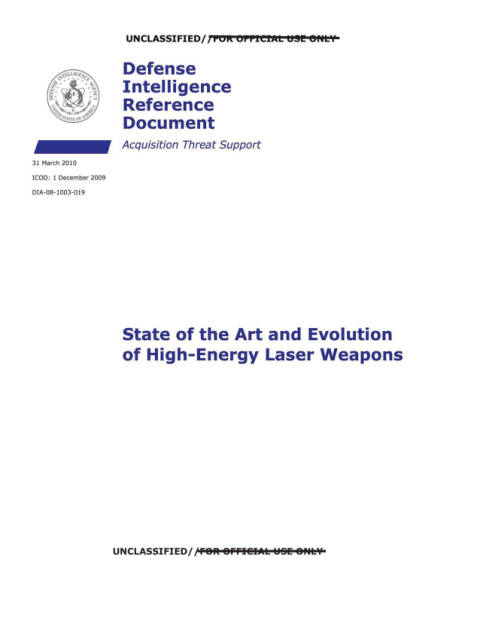
Official summary, as published
This document is a Defense Intelligence Reference Document (DIRD), a technical reference format used by the Defense Intelligence Agency (DIA) to capture baseline knowledge on a specific topic for later analytic use. DIRDs are best understood as reference and synthesis products rather than as original research. It is one of 38 DIRDs produced under the Advanced Aerospace Weapon System Applications Program (AAWSAP) between 2009 and 2011. Because AAWSAP’s scope permitted a broad range of supporting topics, not every DIRD in the series directly concerns aerospace systems or future threat assessment. The following summary reflects the DIRD’s scope and framing at the time of writing and should not be read as implying current validation of the concepts discussed.
This DIRD surveys the development of high-energy laser weapons and notes that, although lasers had already become important military tools for ranging, guidance, and other lower-power uses, true weapon-class systems remained limited by power generation, beam control, atmospheric propagation, and logistics. The report reviews major laser types along with the optical, tracking, and thermal-management systems needed to make them militarily useful. It argues that high-energy lasers can offer important advantages over kinetic weapons in speed, precision, and low collateral damage, especially against softer or fast-moving targets, while also emphasizing that practical deployment has long been hindered by hazardous chemical fuels, thermal blooming in the atmosphere, power-supply constraints for mobile systems, and waste-heat removal.
Named in this file
2 namesPeople, programs and institutions from The Legacy Program research board whose names appear in this file, found by exact spelling against a hand-checked list. A match says only that the file names them, not what part they play. People and programs lists every file that names each one.
- Tier A Advanced Aerospace Weapon System Applications Program (AAWSAP) program
Named in the title and the official summary.
dia-program
- Tier A Defense Intelligence Agency institution
Named in the official summary and pages 1, 2.
Combat support agency; AAWSAP/AATIP executive agent
Our reading
Reading in progress
We have not published a reading of DOW-UAP-D137 yet. The official summary above is all there is for now.
Our saved copy
One version seen. The checksum lets you confirm that a copy you hold is the one we saved.
-
First seen
34.4 MB (36,030,969 bytes)
SHA-256
d397fc90f994bc6002c98c9ff8de02fb91007c8357076a51eabce30ee2ac5974