RELEASE 06 / DOW-UAP-D135
DOW-UAP-D135, AAWSAP DIRD, Antigravity for Aerospace Applications, March 2010
- File ID
- DOW-UAP-D135
- Agency
- Department of War
- Release
- Release 06, 18 Sep 2026
- Event date
- 3/30/2010 (read as 30 Mar 2010; precision: day)
- Location
- Las Vegas, Nevada
- Type
- Redactions
- Yes, parts of the official copy are blacked out
The official record
Official copy at war.gov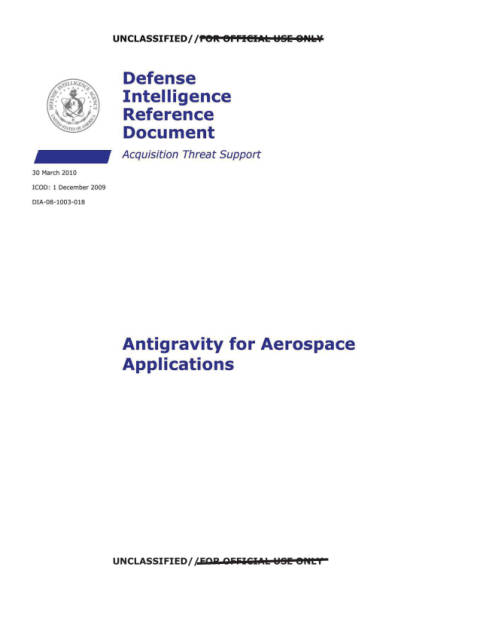
Official summary, as published
This document is a Defense Intelligence Reference Document (DIRD), a technical reference format used by the Defense Intelligence Agency (DIA) to capture baseline knowledge on a specific topic for later analytic use. DIRDs are best understood as reference and synthesis products rather than as original research. It is one of 38 DIRDs produced under the Advanced Aerospace Weapon System Applications Program (AAWSAP) between 2009 and 2011. Because AAWSAP’s scope permitted a broad range of supporting topics, not every DIRD in the series directly concerns aerospace systems or future threat assessment. The following summary reflects the DIRD’s scope and framing at the time of writing and should not be read as implying current validation of the concepts discussed.
This DIRD surveys a range of proposed “antigravity,” or gravitational control, concepts for aerospace applications, drawing mainly from Newtonian gravity, general relativity, cosmology, and quantum field theory to hypothesize that gravity might someday be reduced, counteracted, or redirected as a means of propulsion. The report reviews mechanisms including ultra-dense matter, gravitomagnetic effects, relativistic moving masses, negative energy, dark or vacuum energy, and quantum vacuum or dispersion-force approaches, while presenting some of these ideas as theoretically permissible under extreme, idealized conditions within established physics. However, it notes that any practical implementation faces currently insurmountable engineering barriers, including astronomical energy requirements, currently unproven exotic matter conditions, kilometer-scale or otherwise unbuildable apparatuses, and highly immature experimental foundations. Although the report draws on broadly accepted theoretical concepts, its implication that those concepts might eventually yield viable “antigravity” propulsion systems deviates significantly from mainstream physics consensus.
Named in this file
6 namesPeople, programs and institutions from The Legacy Program research board whose names appear in this file, found by exact spelling against a hand-checked list. A match says only that the file names them, not what part they play. People and programs lists every file that names each one.
- Tier A Eric W. Davis person
Named in page 43.
Astrophysicist, EarthTech International; five-time AAWSAP DIRD author
- Tier A Harold E. Puthoff person
Named in page 43.
President, EarthTech International; AAWSAP DIRD author; former SRI remote-viewing program director
- Tier B Marc G. Millis person
Named in page 43.
Former NASA propulsion engineer, founder of the Tau Zero Foundation; author, DIRD 'Cockpits in the Era of Breakthrough Flight' (DIA-08-1011-002)
- Tier A Advanced Aerospace Weapon System Applications Program (AAWSAP) program
Named in the title and the official summary.
dia-program
- Tier A Defense Intelligence Agency institution
Named in the official summary and pages 1, 2.
Combat support agency; AAWSAP/AATIP executive agent
- Tier B Air Force Research Laboratory institution
Named in page 39.
Single Air Force science and technology laboratory, headquartered at Wright-Patterson AFB, Ohio
Our reading
Reading in progress
We have not published a reading of DOW-UAP-D135 yet. The official summary above is all there is for now.
Our saved copy
One version seen. The checksum lets you confirm that a copy you hold is the one we saved.
-
First seen
56.3 MB (58,982,424 bytes)
SHA-256
a97c6847c520fdf7455bfd0d8829df910ac5aeaf6f0f7fb4186c66935ce45a33