RELEASE 06 / DOW-UAP-D134
DOW-UAP-D134, AAWSAP DIRD, Maverick Inventor Versus Corporate Inventor: Where Will the Next Major Innovations Arise, March 2010
- File ID
- DOW-UAP-D134
- Agency
- Department of War
- Release
- Release 06, 18 Sep 2026
- Event date
- 3/30/2010 (read as 30 Mar 2010; precision: day)
- Location
- Las Vegas, Nevada
- Type
- Redactions
- Yes, parts of the official copy are blacked out
The official record
Official copy at war.gov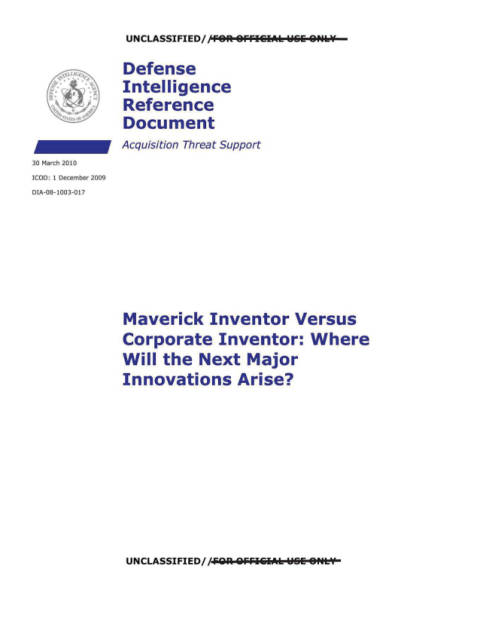
Official summary, as published
This document is a Defense Intelligence Reference Document (DIRD), a technical reference format used by the Defense Intelligence Agency (DIA) to capture baseline knowledge on a specific topic for later analytic use. DIRDs are best understood as reference and synthesis products rather than as original research. It is one of 38 DIRDs produced under the Advanced Aerospace Weapon System Applications Program (AAWSAP) between 2009 and 2011. Because AAWSAP’s scope permitted a broad range of supporting topics, not every DIRD in the series directly concerns aerospace systems or future threat assessment. The following summary reflects the DIRD’s scope and framing at the time of writing and should not be read as implying current validation of the concepts discussed.
This DIRD compares lone “maverick” inventors with researchers working inside larger organizations in order to ask where major future breakthroughs are most likely to come from, especially in unconventional energy and propulsion. It concludes that the strongest candidates are technically trained, relatively independent, and flexible researchers working with some freedom from institutional constraint. Because that preferred profile closely resembles the kind of researcher who appears to have authored or shaped much of the broader AAWSAP DIRD effort, the document reflects a notable methodological circularity, validating the program’s operational model rather than neutrally assessing the innovation ecosystem.
Named in this file
8 namesPeople, programs and institutions from The Legacy Program research board whose names appear in this file, found by exact spelling against a hand-checked list. A match says only that the file names them, not what part they play. People and programs lists every file that names each one.
- Tier B Marc G. Millis person
Named in pages 17, 18, 19.
Former NASA propulsion engineer, founder of the Tau Zero Foundation; author, DIRD 'Cockpits in the Era of Breakthrough Flight' (DIA-08-1011-002)
- Tier A Advanced Aerospace Weapon System Applications Program (AAWSAP) program
Named in the title and the official summary.
dia-program
- Tier A Defense Intelligence Agency institution
Named in the official summary and pages 1, 2.
Combat support agency; AAWSAP/AATIP executive agent
- Tier B Lawrence Livermore National Laboratory institution
Named in page 8.
DOE FFRDC administered by Lawrence Livermore National Security, LLC since 1 October 2007; Livermore, CA
- Tier B Lockheed Martin Advanced Development Programs (Skunk Works) institution
Named in page 8.
Unacknowledged-program aeronautics organisation, Burbank then Palmdale
- Tier A National Aeronautics and Space Administration institution
Named in pages 8, 17, 19.
Civil space agency; host of the 2023 UAP Independent Study Team
- Tier A Sandia National Laboratories institution
Named in page 8.
DOE national laboratory, Albuquerque, NM
- Tier B SRI International (Stanford Research Institute) institution
Named in page 8.
Independent nonprofit research institute; host of the CIA/DIA psychoenergetics programme 1972-1990
Our reading
Reading in progress
We have not published a reading of DOW-UAP-D134 yet. The official summary above is all there is for now.
Our saved copy
One version seen. The checksum lets you confirm that a copy you hold is the one we saved.
-
First seen
24.4 MB (25,627,490 bytes)
SHA-256
52e47ca04c0de85d1c6f8ee86103e69803785fddd0ec19daa20b38cb190e0309