RELEASE 06 / DOW-UAP-D131
DOW-UAP-D131, AAWSAP DIRD, The Role of Superconductors in Gravity Research, March 2010
- File ID
- DOW-UAP-D131
- Agency
- Department of War
- Release
- Release 06, 18 Sep 2026
- Event date
- 3/23/2010 (read as 23 Mar 2010; precision: day)
- Location
- Las Vegas, Nevada
- Type
- Redactions
- Yes, parts of the official copy are blacked out
The official record
Official copy at war.gov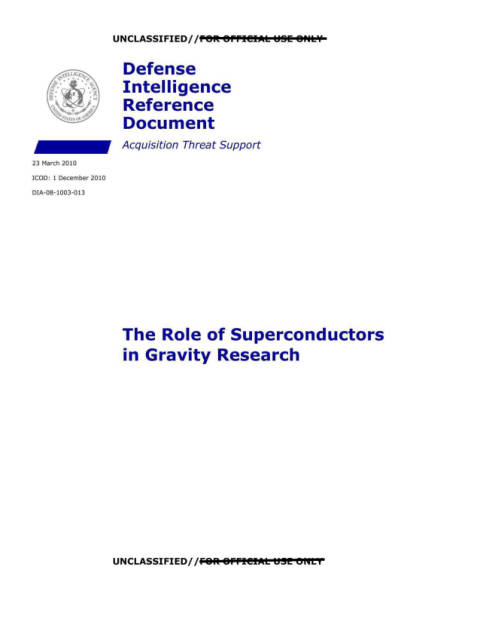
Official summary, as published
This document is a Defense Intelligence Reference Document (DIRD), a technical reference format used by the Defense Intelligence Agency (DIA) to capture baseline knowledge on a specific topic for later analytic use. DIRDs are best understood as reference and synthesis products rather than as original research. It is one of 38 DIRDs produced under the Advanced Aerospace Weapon System Applications Program (AAWSAP) between 2009 and 2011. Because AAWSAP’s scope permitted a broad range of supporting topics, not every DIRD in the series directly concerns aerospace systems or future threat assessment. The following summary reflects the DIRD’s scope and framing at the time of writing and should not be read as implying current validation of the concepts discussed.
This DIRD is a historical survey of efforts to determine whether superconductors might play a role in producing, detecting, or modifying gravity-related effects in a laboratory setting. It reviews the main theoretical and experimental lines of work in that area and attempts to connect superconducting materials with gravitational-wave or propulsion-related concepts. Because the topic is highly contested within the scientific literature, the report spends substantial attention on experiments of disputed value and on controversial theories, especially claims that rotating or energized superconductors might generate anomalous gravitational effects. Overall, the document treats the subject as an exploratory research area with potentially major implications if any real effect were verified, while also making clear that the evidentiary base remained weak, that prominent claims had not been convincingly replicated, and that both the underlying theory and the experimental record remained deeply disputed.
Named in this file
7 namesPeople, programs and institutions from The Legacy Program research board whose names appear in this file, found by exact spelling against a hand-checked list. A match says only that the file names them, not what part they play. People and programs lists every file that names each one.
- Tier A Harold E. Puthoff person
Named in pages 5, 15.
President, EarthTech International; AAWSAP DIRD author; former SRI remote-viewing program director
- Tier A Eric W. Davis person
Named in pages 14, 16.
Astrophysicist, EarthTech International; five-time AAWSAP DIRD author
- Tier A Advanced Aerospace Weapon System Applications Program (AAWSAP) program
Named in the title and the official summary.
dia-program
- Tier A Defense Intelligence Agency institution
Named in the official summary and pages 1, 2.
Combat support agency; AAWSAP/AATIP executive agent
- Tier A National Aeronautics and Space Administration institution
Named in pages 10, 11, 12, 13, 16.
Civil space agency; host of the 2023 UAP Independent Study Team
- Tier A The MITRE Corporation institution
Named in page 15.
Not-for-profit operator of six FFRDCs; dual headquarters McLean, VA and Bedford, MA; founded 21 July 1958
- Tier B Los Alamos National Laboratory institution
Named in page 16.
DOE FFRDC administered by Triad National Security, LLC since 9 June 2018; Los Alamos, NM
Our reading
Reading in progress
We have not published a reading of DOW-UAP-D131 yet. The official summary above is all there is for now.
Our saved copy
One version seen. The checksum lets you confirm that a copy you hold is the one we saved.
-
First seen
24.2 MB (25,389,878 bytes)
SHA-256
224275259e7e168019c69abd955f80ee6417649a47c5036e4783e0969e863c43