RELEASE 06 / DOW-UAP-D130
DOW-UAP-D130, AAWSAP DIRD, Technological Approaches to Controlling External Devices, March 2010
- File ID
- DOW-UAP-D130
- Agency
- Department of War
- Release
- Release 06, 18 Sep 2026
- Event date
- 3/23/2010 (read as 23 Mar 2010; precision: day)
- Location
- Las Vegas, Nevada
- Type
- Redactions
- Yes, parts of the official copy are blacked out
The official record
Official copy at war.gov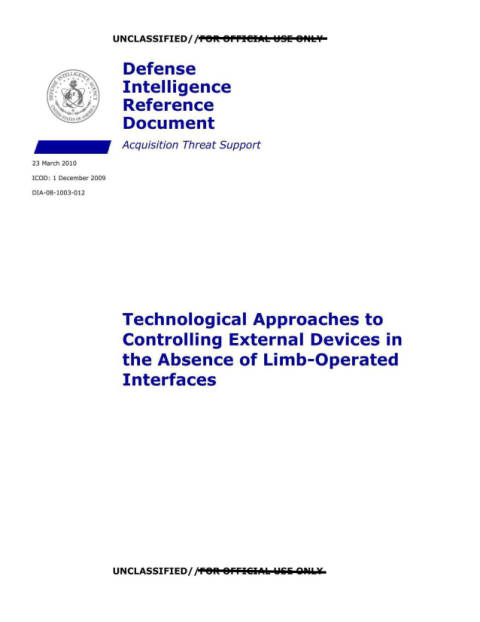
Official summary, as published
This document is a Defense Intelligence Reference Document (DIRD), a technical reference format used by the Defense Intelligence Agency (DIA) to capture baseline knowledge on a specific topic for later analytic use. DIRDs are best understood as reference and synthesis products rather than as original research. It is one of 38 DIRDs produced under the Advanced Aerospace Weapon System Applications Program (AAWSAP) between 2009 and 2011. Because AAWSAP’s scope permitted a broad range of supporting topics, not every DIRD in the series directly concerns aerospace systems or future threat assessment. The following summary reflects the DIRD’s scope and framing at the time of writing and should not be read as implying current validation of the concepts discussed.
This DIRD surveys brain-machine interface technologies intended to allow users to control external devices without conventional manual controls, and it evaluates both noninvasive and invasive approaches for turning neural or related physiological signals into usable commands. The report reviews the underlying neural signals, distinguishes between open- and closed-loop control systems, and examines technologies including scalp-based electrical recording, magnetic and imaging-based methods, and implanted cortical interfaces, with particular attention to bandwidth, response time, signal quality, and practical usability. It concludes that, in the near term, the most practical systems are likely to be noninvasive electrical approaches that draw heavily on muscle and neural signals, while longer-term high-bandwidth control would likely require more advanced invasive interfaces capable of robust two-way communication with individual neurons. The document presents thought-based control of external devices as a research field with plausible assistive and specialized applications, while emphasizing that naturalistic, high-performance control remained constrained by major technical and physiological limits.
Named in this file
2 namesPeople, programs and institutions from The Legacy Program research board whose names appear in this file, found by exact spelling against a hand-checked list. A match says only that the file names them, not what part they play. People and programs lists every file that names each one.
- Tier A Advanced Aerospace Weapon System Applications Program (AAWSAP) program
Named in the title and the official summary.
dia-program
- Tier A Defense Intelligence Agency institution
Named in the official summary and pages 1, 2.
Combat support agency; AAWSAP/AATIP executive agent
Our reading
Reading in progress
We have not published a reading of DOW-UAP-D130 yet. The official summary above is all there is for now.
Our saved copy
One version seen. The checksum lets you confirm that a copy you hold is the one we saved.
-
First seen
52.7 MB (55,276,564 bytes)
SHA-256
6df90d61b653620ef55ca9ccaefad11a227079a8b20c94b038a1ef819b92bb07