RELEASE 06 / DOW-UAP-D126
DOW-UAP-D126, AAWSAP DIRD, Advanced Nuclear Propulsion for Manned Deep Space Missions, March 2010
- File ID
- DOW-UAP-D126
- Agency
- Department of War
- Release
- Release 06, 18 Sep 2026
- Event date
- 3/11/2010 (read as 11 Mar 2010; precision: day)
- Location
- Las Vegas, Nevada
- Type
- Redactions
- Yes, parts of the official copy are blacked out
The official record
Official copy at war.gov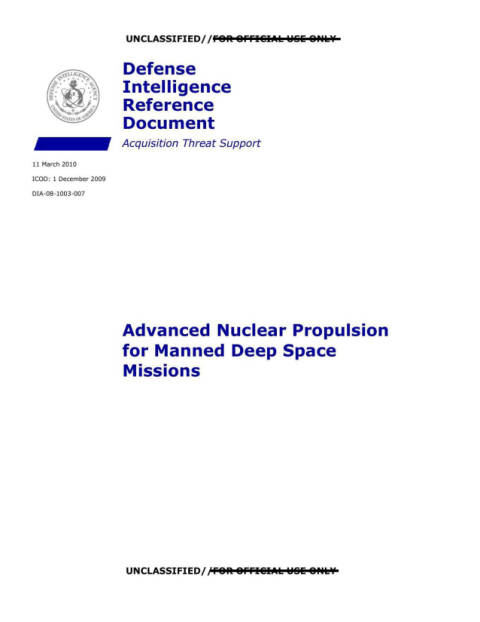
Official summary, as published
This document is a Defense Intelligence Reference Document (DIRD), a technical reference format used by the Defense Intelligence Agency (DIA) to capture baseline knowledge on a specific topic for later analytic use. DIRDs are best understood as reference and synthesis products rather than as original research. It is one of 38 DIRDs produced under the Advanced Aerospace Weapon System Applications Program (AAWSAP) between 2009 and 2011. Because AAWSAP’s scope permitted a broad range of supporting topics, not every DIRD in the series directly concerns aerospace systems or future threat assessment. The following summary reflects the DIRD’s scope and framing at the time of writing and should not be read as implying current validation of the concepts discussed.
This DIRD examines advanced nuclear propulsion for crewed deep-space travel and argues that human missions beyond the Moon would require propulsion systems with both very high thrust and very high specific impulse, which the author contends are difficult to achieve with conventional chemical, nuclear-thermal, and nuclear-electric systems. The report focuses on concepts derived from Project Orion, the discontinued General Atomics nuclear pulse propulsion study sponsored first by ARPA and later by the U.S. Air Force between 1958 and 1965, in which a spacecraft would be driven by repeated nuclear explosions. In this case, the DIRD emphasizes small non-fission-triggered fusion explosions using deuterium, magnetic mirrors, and other unconventional ignition concepts intended to avoid the inefficiencies associated with small fission devices. It presents these ideas as a possible pathway to crewed missions across the solar system, while also linking them to broader visions of long-range human expansion into space. The document is exploratory in character and depends on several unproven ignition methods, enabling technologies, and engineering assumptions. Overall, it is a theoretical examination of fusion-based pulse propulsion concepts rather than as a documentary account of a technology nearing practical realization.
Named in this file
6 namesPeople, programs and institutions from The Legacy Program research board whose names appear in this file, found by exact spelling against a hand-checked list. A match says only that the file names them, not what part they play. People and programs lists every file that names each one.
- Tier C Claudio Maccone person
Named in page 7.
Italian SETI astronomer and mathematician; International Academy of Astronautics (Chair, SETI Permanent Committee; Director for Scientific Space Exploration). 1948-2025
- Tier B Friedwardt Winterberg person
Named in pages 36, 37.
Theoretical physicist, Research Professor, University of Nevada, Reno; author of two AAWSAP DIRDs
- Tier A Advanced Aerospace Weapon System Applications Program (AAWSAP) program
Named in the title and the official summary.
dia-program
- Tier A Defense Intelligence Agency institution
Named in the official summary and pages 1, 2.
Combat support agency; AAWSAP/AATIP executive agent
- Tier C General Atomics institution
Named in the official summary.
Privately held; fusion research, unmanned aircraft, DOE and DARPA programs
- Tier A Atomic Energy Commission institution
Named in page 37.
Civilian atomic authority, 1946-1974; statutory custodian of fissionable material and atomic weapons
Our reading
Reading in progress
We have not published a reading of DOW-UAP-D126 yet. The official summary above is all there is for now.
Our saved copy
One version seen. The checksum lets you confirm that a copy you hold is the one we saved.
-
First seen
44.5 MB (46,636,507 bytes)
SHA-256
087bbb392b8396590724d5eb7d39f15cac23924f8fb411723b807b2665ea9241