RELEASE 06 / DOW-UAP-D122
DOW-UAP-D122, AAWSAP DIRD, Invisibility Cloaking Theory and Experiments, March 2010
- File ID
- DOW-UAP-D122
- Agency
- Department of War
- Release
- Release 06, 18 Sep 2026
- Event date
- 3/2/2010 (read as 2 Mar 2010; precision: day)
- Location
- Las Vegas, Nevada
- Type
- Redactions
- Yes, parts of the official copy are blacked out
The official record
Official copy at war.gov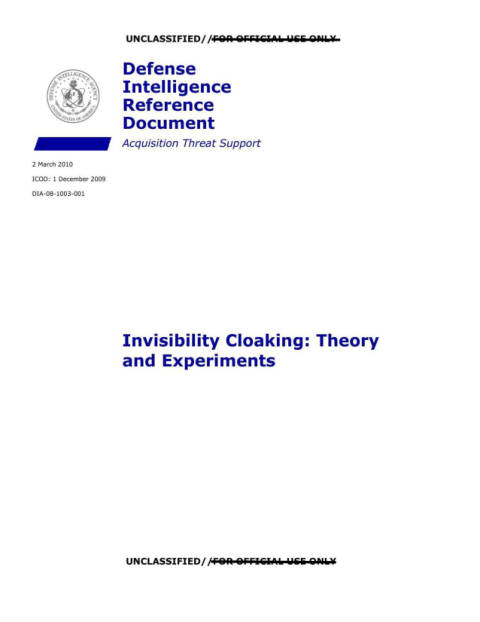
Official summary, as published
This document is a Defense Intelligence Reference Document (DIRD), a technical reference format used by the Defense Intelligence Agency (DIA) to capture baseline knowledge on a specific topic for later analytic use. DIRDs are best understood as reference and synthesis products rather than as original research. It is one of 38 DIRDs produced under the Advanced Aerospace Weapon System Applications Program (AAWSAP) between 2009 and 2011. Because AAWSAP’s scope permitted a broad range of supporting topics, not every DIRD in the series directly concerns aerospace systems or future threat assessment. The following summary reflects the DIRD’s scope and framing at the time of writing and should not be read as implying current validation of the concepts discussed.
This DIRD surveys the theory and early experiments behind invisibility cloaking, describing several ways an object might be hidden from visual or sensor detection, including camouflage, transparency effects, and optical cloaking that bends light around an object. It focuses mainly on metamaterials, negative refraction, and transformation optics, and reviews experiments that had already demonstrated limited cloaking at microwave frequencies. The report argues that “imperfect” cloaking is physically achievable in some parts of the electromagnetic spectrum, especially for microwaves, but that “perfect” cloaking is not practical because it would require material properties that conflict with the underlying physics. Its overall conclusion is that cloaking is a scientific field with plausible narrow applications, but that useful visible-light cloaking depends more on future theoretical breakthroughs than on conventional advances in materials science.
Named in this file
3 namesPeople, programs and institutions from The Legacy Program research board whose names appear in this file, found by exact spelling against a hand-checked list. A match says only that the file names them, not what part they play. People and programs lists every file that names each one.
- Tier C Ulf Leonhardt person
Named in pages 14, 28, 29.
Theoretical physicist, University of St Andrews; author, DIRD 'Invisibility Cloaking: Theory and Experiments' (DIA-08-1003-001)
- Tier A Advanced Aerospace Weapon System Applications Program (AAWSAP) program
Named in the title and the official summary.
dia-program
- Tier A Defense Intelligence Agency institution
Named in the official summary and pages 1, 2.
Combat support agency; AAWSAP/AATIP executive agent
Our reading
Reading in progress
We have not published a reading of DOW-UAP-D122 yet. The official summary above is all there is for now.
Our saved copy
One version seen. The checksum lets you confirm that a copy you hold is the one we saved.
-
First seen
32.1 MB (33,674,009 bytes)
SHA-256
e603ffbc39458140aadf4610b048d44c2162ca4feb4492b1ea9270b1da8508da