RELEASE 06 / DOW-UAP-D119
DOW-UAP-D119, AAWSAP DIRD, Biomaterials, January 2010
- File ID
- DOW-UAP-D119
- Agency
- Department of War
- Release
- Release 06, 18 Sep 2026
- Event date
- 1/7/2010 (read as 7 Jan 2010; precision: day)
- Location
- Las Vegas, Nevada
- Type
- Redactions
- Yes, parts of the official copy are blacked out
The official record
Official copy at war.gov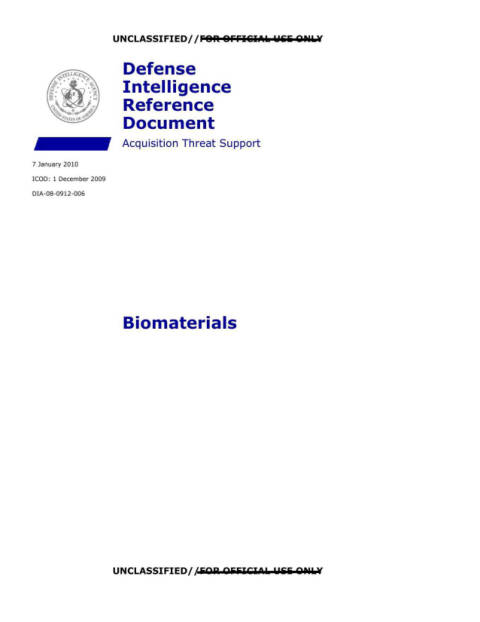
Official summary, as published
This document is a Defense Intelligence Reference Document (DIRD), a technical reference format used by the Defense Intelligence Agency (DIA) to capture baseline knowledge on a specific topic for later analytic use. DIRDs are best understood as reference and synthesis products rather than as original research. It is one of 38 DIRDs produced under the Advanced Aerospace Weapon System Applications Program (AAWSAP) between 2009 and 2011. Because AAWSAP’s scope permitted a broad range of supporting topics, not every DIRD in the series directly concerns aerospace systems or future threat assessment. The following summary reflects the DIRD’s scope and framing at the time of writing and should not be read as implying current validation of the concepts discussed.
This DIRD is a broad survey of biomaterials, including metals, polymers, ceramics, glasses, and composites designed to interact with living tissue, and argues that their value depends mainly on biocompatibility, reliability, and careful matching of material properties to specific medical uses. The report reviews major application areas including biosensors, implants, cardiovascular devices, contact lenses, drug delivery systems, tissue constructs, titanium devices, and dialysis membranes, emphasizing that no single biomaterial works best in every setting. Its overall conclusion is that biomaterials are already foundational to a large medical-device industry and save or improve millions of lives, but that progress tends to be slow because safety testing is stringent; as a result, most advances come from improved ways of applying established materials such as silicone, Teflon, biodegradable polymers, ceramics, and titanium in new devices and clinical settings rather than from radically new substances.
Named in this file
2 namesPeople, programs and institutions from The Legacy Program research board whose names appear in this file, found by exact spelling against a hand-checked list. A match says only that the file names them, not what part they play. People and programs lists every file that names each one.
- Tier A Advanced Aerospace Weapon System Applications Program (AAWSAP) program
Named in the title and the official summary.
dia-program
- Tier A Defense Intelligence Agency institution
Named in the official summary and pages 1, 2.
Combat support agency; AAWSAP/AATIP executive agent
Our reading
Reading in progress
We have not published a reading of DOW-UAP-D119 yet. The official summary above is all there is for now.
Our saved copy
One version seen. The checksum lets you confirm that a copy you hold is the one we saved.
-
First seen
38.4 MB (40,222,683 bytes)
SHA-256
535c4e3cb92b7519c109da7d3ba173bae036463e5661ff6040ae37f8c9f8ce31